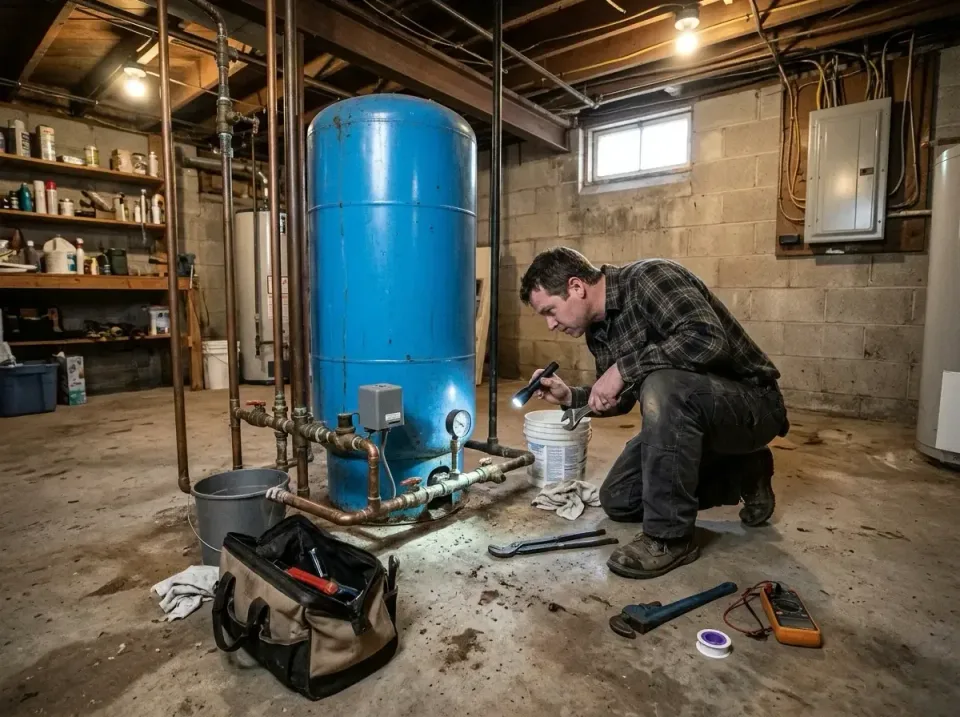
Water Pressure Tank Repair
We repair potable-water pressure tanks for homes, checking tank size and connections; replacement commonly runs $800–$2,500, driven by tank size and installation access.
A washer that fills slowly may have a restricted inlet, a partly closed shutoff, or low pressure affecting more than one fixture. Start by checking the washer hoses and whether other taps have weak flow; don’t adjust pump controls yet.
If the problem is limited to the washer, the hose screens may be clogged. If several fixtures are affected, the pressure system needs a closer look.
Around the University of Alaska Anchorage, older or heavily used plumbing can make a small restriction noticeable during a laundry cycle. Near the Anchorage Alaska Railroad Depot, access to equipment and any required municipal inspection coordination can affect how a repair is planned. We explain findings before recommending work. Check one fixture first.
If only the washer fills slowly, inspect the hot and cold shutoff valves and look for a kinked hose. Turn the valves fully open if they are safe to operate, then check whether the hoses are sharply bent behind the machine.
Close the valves before disconnecting anything. Small inlet screens can collect flushed sediment and mineral scale, especially after plumbing work or a change in water flow.
Clean them only if you can shut off water and reconnect the hoses securely; don’t force brittle fittings.
If the kitchen or bathroom taps also run weakly, the washer may only be showing a wider pressure problem. Our crew compares what happens at the washer with the flow at another fixture before pointing to a cause. Read why faucet pressure drops when another fixture runs in Alaska if the change appears when another tap is used.
A pressure gauge reading taken with no water running is not the whole story. A system may show acceptable static pressure and still lose dynamic pressure as the washer draws water.
On a private well, listen for repeated pump starts or pressure that rises and falls during the fill. In Interior Alaska, where winter cold can be severe, exposed or poorly protected piping also deserves a visual check for freezing-related damage. Don’t thaw a pipe with an open flame.
The Alaska Native Heritage Center is a familiar Anchorage-area reference point, but homes throughout the state have different water-system layouts; note whether the washer is near a utility room, crawlspace, or outside wall. We diagnose from the system’s behavior rather than assuming a pump is at fault. If the pump cycles repeatedly, learn how a pressure tank can contribute to well pump cycling.
DIY checks and call a pro?
You can usually check a visible kink, confirm a valve position, and compare the washer fill with another faucet. Stop before opening pump controls, handling wiring, or changing switch settings. Those steps can create electrical and pressure hazards, and an incorrect adjustment may hide the original fault.
A slow fill plus weak flow at several fixtures points beyond the washer. The University of Alaska Fairbanks can be a useful reference for the Interior, where winter cold puts extra emphasis on checking accessible plumbing for exposure; it is not a substitute for diagnosing a home’s system.
We use a digital multimeter for pump circuits when electrical testing is part of the diagnosis, rather than guessing from sound alone. Ask us to inspect the equipment and explain the findings before authorizing a repair.
A washer may fill slowly after an outage or a change in water supply, so note when the symptom started and whether the pump or other fixtures changed at the same time. Along the Alaska Highway, distance and access can affect how service visits are arranged; having the well equipment and shutoff locations identified helps use that visit efficiently. Western Alaska coastal storms can also disrupt service access, so explain any travel or access constraints when scheduling.
At the Alaska SeaLife Center, water is central to the facility’s work; in a home, a washer’s fill rate is a practical clue about the water reaching the appliance. Our detailed system performance review checks the symptom across fixtures and equipment before we recommend a repair. For Alaska homes, matching the diagnosis to the actual system matters more than replacing the first part that looks worn.
The right check depends on whether the restriction is at the washer or the pressure system. Don’t replace equipment based on one symptom alone.
| Option | Best for | Key detail |
|---|---|---|
| Washer hose and inlet screen check | One washer fills slowly | Check for a kink and flushed sediment or mineral scale before suspecting the pump. |
| Well pressure diagnosis | Washer and other fixtures have weak flow | A pump supplies water; a tank stores it. Diagnosis separates a system issue from an appliance restriction. |
| Pressure tank assessment | Pressure changes during a fill | Residential tanks range from 20–86 gallons; tank size alone does not show usable drawdown. |
| Switch or pump inspection | Pump starts repeatedly or fails to maintain flow | Switch settings commonly include 20/40 or 30/50 psi; do not adjust controls without proper testing. |
A clear 36-inch access path to equipment helps a technician inspect it safely. In Anchorage, a stop near the Anchorage 5th Avenue Mall is a familiar local reference, but access at your home determines the work plan.
A few simple preparations help us trace a slow fill without moving avoidable obstacles. Alaska’s summer temperatures vary widely, while freeze-thaw cycles can stress buried pipes and foundations; mention recent thawing or visible ground changes if you have noticed them. If the washer has stopped filling altogether, tell us when the problem began so we can discuss whether emergency service is appropriate.
Note the symptom: Record whether the washer is slow on hot, cold, or both settings, and when you first noticed it.
Compare fixtures: Run a nearby tap briefly and note whether its flow changes while the washer fills.
Locate equipment: Identify the wellhead, pressure tank, and shutoff if accessible; don’t open electrical controls.
Clear the route: Move stored items from the utility room and protect the floor along the equipment path.
Plan winter access: Clear snow around a covered wellhead without disturbing piping; Eagle River Nature Center is a familiar regional landmark, but your home’s access conditions guide the visit.
Allow for interruption: Arrange for a temporary water interruption if testing or repair requires it, then confirm normal flow after work.
A washer that fills slowly while other fixtures seem normal may have a kinked supply hose, partly closed valve, or obstructed inlet screen. Check visible hose bends first, then shut off water before inspecting a screen; flushed sediment and mineral scale can collect there.
Low Water Pressure Repair diagnosis is listed at $100–$300, including testing and travel; the actual work depends on what testing finds. A pressure switch replacement is $200–$600, with switch and wiring access affecting the job.
Yes, you can check for a kinked hose or a supply valve that is visibly not fully open, provided it turns easily. Call Alaska Plumbing Pros if multiple fixtures lose flow or pump controls need testing; we use a digital multimeter for pump circuits when appropriate.
Anchorage plumbing permits should be verified before alterations, and applicable Alaska Plumbing Code requirements depend on the work. If pump wiring is involved, Anchorage electrical permits may require approval; ask the Municipality of Anchorage Development Services Department before changing the installation.
Water Pressure Tank Repair may help if pressure changes or pump cycling accompany the washer’s slow fill, but a washer-only restriction can have a different cause. A technician can compare flow at other fixtures and inspect the tank system before recommending work.
If the washer alone fills slowly, start with the hose, shutoff, and inlet screen. If several fixtures weaken together, the pressure system may need diagnosis rather than an appliance adjustment.
Alaska’s high winds can damage exposed plumbing components, so report any visible outdoor damage along with the washer symptom. Our crew provides booster pump system service when testing shows that equipment is involved, and we explain the findings before recommending a repair. Don’t guess at wiring.
Describe the change: Tell us whether other taps are affected.
Share what you checked: Note hose kinks, valve position, and when the issue began.
Arrange an assessment: Keep the route to accessible equipment clear.
For a measured inspection and a repair recommendation suited to your setup, contact Alaska Plumbing Pros at (877) 773-0781 or review our Low Water Pressure Repair service.
A washer that fills slowly while other fixtures seem normal may have a kinked supply hose, partly closed valve, or obstructed inlet screen. Check visible hose bends first, then shut off water before inspecting a screen; flushed sediment and mineral scale can collect there.
Low Water Pressure Repair diagnosis is listed at $100–$300, including testing and travel; the actual work depends on what testing finds. A pressure switch replacement is $200–$600, with switch and wiring access affecting the job.
Yes, you can check for a kinked hose or a supply valve that is visibly not fully open, provided it turns easily. Call Alaska Plumbing Pros if multiple fixtures lose flow or pump controls need testing; we use a digital multimeter for pump circuits when appropriate.
Anchorage plumbing permits should be verified before alterations, and applicable Alaska Plumbing Code requirements depend on the work. If pump wiring is involved, Anchorage electrical permits may require approval; ask the Municipality of Anchorage Development Services Department before changing the installation.
Water Pressure Tank Repair may help if pressure changes or pump cycling accompany the washer’s slow fill, but a washer-only restriction can have a different cause. A technician can compare flow at other fixtures and inspect the tank system before recommending work.
Browse all nationwide service options and choose the right fit for your project.
We repair potable-water pressure tanks for homes, checking tank size and connections; replacement commonly runs $800–$2,500, driven by tank size and installation access.
Booster Pump Repair covers pump diagnostics and component fixes for homes with inconsistent supply; typical repairs run $300–$1,200, depending on parts and diagnostics.
Well Pump Repair covers pump testing and repairs for homes, with replacement costs of $1,200–$4,500 depending on pump depth and type.
We repair leaking water lines for homeowners and contractors, including accessible pipe sections and excavation; repairs commonly run $400–$3,000 depending on pipe access.
Frozen Pipe Repair for Alaska homes includes locating and safely thawing frozen pipe sections; access, pipe material, and any split line affect the job scope.
We repair residential pressure regulators, checking valve condition and system readings; access and regulator size shape the job, typically $150–$400.
We diagnose sudden household pressure drops, testing flowing and static readings and system controls. Typical diagnostic visits run $100–$300, depending on testing and travel.
We repair or replace household shutoff valves, including accessible copper and PEX connections; typical jobs run $150–$500 depending on access and valve condition.
Clear clogged residential water lines and inspect accessible pipe sections; typical jobs run $250–$1,500, with price driven by blockage and access.
We repair well pressure switches for homeowners, including switch and wiring access; typical replacement runs $200–$600, depending on access.
Goulds Well Pump Repair covers residential pump diagnosis and component repairs; access, pump depth, and parts availability shape the job cost.
We repair residential water softeners, including control and resin-bed issues; diagnostic work is $100–$300, depending on testing and travel.
Shallow Well Pump Repair covers pump, foot-valve, and check-valve faults for private-well homes; access, pump type, and well depth shape the job cost.
Sediment Filter Replacement clears packed grit from residential filter housings; typical cartridge jobs run $150–$450, depending on filter size and access.
Air-in-line diagnosis and repair for Alaska homes, including accessible water-line checks; typical service runs $150–$500, depending on access and repair scope.
Submersible pump repair for Alaska homes includes well-depth and pump checks; replacement work typically runs $1,200–$4,500, depending on depth and pump type.
Grundfos Booster Pump Repair in Alaska: diagnose pump faults, inspect controls, and repair components. Call (877) 773-0781 for a scope review.
Select a city to find local low water pressure repair providers we cover in Alaska.
Share your job scope for low water pressure repair in Alaska — we will review fit and pricing before scheduling.