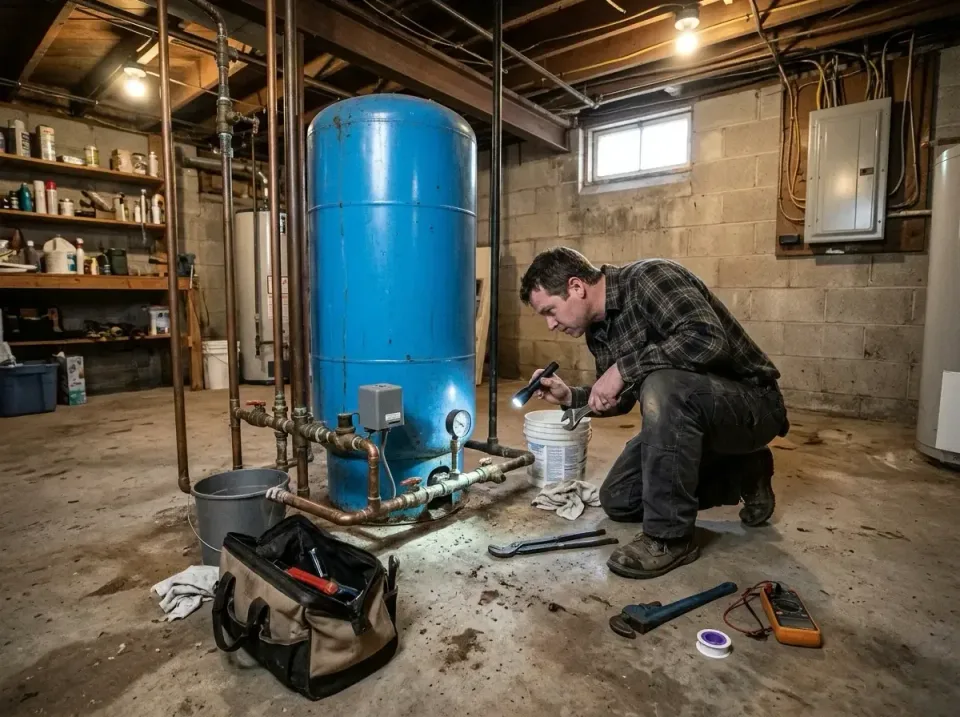
Water Pressure Tank Repair
We repair potable-water pressure tanks for homes, checking tank size and connections; replacement commonly runs $800–$2,500, driven by tank size and installation access.
If the power returns but your shower stays weak or several faucets barely run, check whether the well pump has power before assuming a pipe is blocked. Do not open electrical controls.
A pump may need safe diagnosis, not a reset guessed at from the breaker panel. Our crew has worked on Alaska well systems for more than 11 years, and we start by comparing pressure behavior with the pump’s response.
Spring thaw can shift or expose damaged water lines, so a pressure problem that lingers after an outage may not come from the pump alone. Long winters also raise the chance of frozen piping or well-system trouble.
On homes reached by the Alaska Highway, remote access can make early, clear troubleshooting especially useful.
Low pressure after a power outage can mean the pump has not restarted, but it can also point to a switch, tank, or water-supply problem. Start with safe observations: note whether the pump sounds like it is running, whether the pressure gauge moves, and whether one fixture or the whole house is affected. Don’t repeatedly flip the breaker if it trips; that can signal an electrical fault requiring professional testing.
Snowmelt can raise groundwater around basements, so dampness near a basement water line deserves attention alongside a pressure complaint. A wet area, sudden pressure drop, or pump that runs without restoring flow may warrant a leak investigation rather than repeated resets.
Near Fairbanks International Airport, households with private wells should also keep pump controls accessible for inspection; a blocked route can delay diagnosis when conditions are already difficult. We test the system before recommending a part.
A pump that starts and stops erratically after electricity returns may have a control or pressure-switch issue. We inspect wiring connections and pressure behavior instead of assuming the pump itself has failed. Coastal humidity and salt air accelerate corrosion, which can affect exposed components and connections; visible rust is a reason to request an inspection, not to touch live equipment.
The landmarks help ground local service, not diagnose a particular home. For example, a property owner heading toward Hatcher Pass still needs a site-specific check: the name of a nearby destination cannot tell us whether the tank, switch, or pump is at fault.
Our crew records pressure and observes cycling, then explains the findings in plain language. For a pump that keeps cycling, see our guide to Alaska well pump cycling and pressure tank causes.
You can check whether other household circuits have power, note the gauge reading, and look for an obvious closed water shutoff without removing covers or adjusting wiring. Stop if the breaker trips again, you smell burning, hear unusual motor noise, or see water near electrical equipment. Electrical inspection belongs to a qualified professional.
That distinction matters in Alaska homes served by different well arrangements. A home near the University of Alaska Anchorage and a remote property can have very different equipment access, but both need the same basic caution around energized pump controls.
We keep the electrical diagnosis separate from simple observations a homeowner can make safely. If only one fixture is weak, the cause may be local; if multiple fixtures lose flow together, the well system deserves attention.
Our well pump repair service starts with inspection rather than automatic replacement.
Repeated pump cycling, no water throughout the home, or pressure that falls again soon after returning are signs to arrange a professional assessment. A pump that runs continuously without building pressure can be drawing from a supply or system problem that a reset will not fix.
Record when the outage occurred, when water returned, and whether pressure changed at every fixture. Those details help us distinguish an outage-related control issue from a separate plumbing fault.
Homes near Kodiak National Wildlife Refuge are a reminder that Alaska service settings range from urban to remote; travel and access affect how a visit is planned. If a utility room is crowded or equipment is hard to reach, clear a safe path before the appointment. We explain what testing shows and what repair options fit the actual failure, without replacing parts on a guess.
The symptom pattern helps separate a pump-control fault from a tank or line issue. A site near Anchorage 5th Avenue Mall may be easier to reach than a remote property, but equipment access still shapes the inspection. High winds can damage exposed plumbing components, so include visible outdoor damage in your observations. Choose the check that matches what the system is doing.
| Option | Best for | Key detail |
|---|---|---|
| Well pump pressure repair | Whole-home pressure loss after power returns | Compare gauge readings with pump operation |
| Pressure tank bladder replacement | Pressure swings or frequent cycling | Residential tanks commonly range from 20–86 gallons |
| Well pressure switch replacement | Pump fails to start or cycles irregularly | Common settings include 20/40 or 30/50 psi |
| Booster pump troubleshooting | Pressure remains low despite a functioning well pump | Sizing depends on flow and pressure |
The broad terrain around Wrangell-St. Elias National Park and Preserve underscores why access and exposed equipment matter in Alaska. Near Bering Land Bridge National Preserve, remote conditions can make a clear description of symptoms especially helpful before scheduling.
A little preparation makes the inspection safer and helps us reach the equipment without moving household belongings during the visit. Freeze-thaw cycles stress buried pipes and foundations, so mention any recent ground movement or new wet spots near the line. A home near the Anchorage Alaska Railroad Depot may have different access than a rural property, but the same clear route to controls helps.
Note the symptoms: Write down when power returned and whether pressure is weak at one fixture or throughout the house.
Locate the equipment: Identify the wellhead, pressure tank, and shutoff valve without opening electrical enclosures.
Clear access: Move stored items from the pump controls and make the utility room or crawlspace reachable.
Prepare the route: Protect floors and plan safe access around snow-covered outdoor equipment.
Allow for testing: Expect a temporary water interruption if inspection or repair requires it.
Keep the pump circuit off if an electrical hazard is suspected, and tell us what you observed when arranging service.
Pressure that returns and then fades can mean the pump is not maintaining supply or a control problem remains; note whether the gauge changes while water is flowing. In Interior Alaska, extreme winter cold makes it especially important to report any exposed piping that may have frozen.
Pressure diagnosis is typically $100–$300 for testing and travel, while a pressure switch replacement is commonly $200–$600 depending on switch and wiring access. Alaska Plumbing Pros can inspect the system and explain which repair, if any, the readings support.
Yes, you can check whether the breaker is on and observe the pressure gauge, but stop if the breaker trips again or you hear unusual pump noise. Prudhoe Bay properties face severe cold and permafrost conditions, so avoid disturbing equipment or piping without a safe inspection plan.
Anchorage plumbing permits should be verified before alterations, and pump wiring work may require Anchorage electrical permit approval. The Alaska Plumbing Code sets applicable installation requirements, so confirm the scope before changing plumbing or electrical components.
Yes, a tank problem can contribute to unstable pressure or repeated pump cycling, so a pressure tank check is a useful next step when the pump runs but flow remains inconsistent. Tony Knowles Coastal Trail is a familiar Anchorage landmark, but a home’s actual pressure readings not its location determine the diagnosis.
If pressure stays low after power returns, don’t keep resetting a tripping circuit or adjusting pump controls. A weak shower, slow washer fill, or several fixtures losing flow can point to different faults; accurate testing helps avoid replacing the wrong part.
Heavy snowfall can obstruct access to outdoor equipment, so mention blocked wellheads or buried routes when scheduling. Interior Alaska’s warm summer days and cool nights do not remove the need to protect exposed equipment during colder conditions.
Homes near the Alaska Native Heritage Center and properties farther afield both benefit from a careful diagnosis. For well pump checks, contact Alaska Plumbing Pros at (877) 773-0781 or review our well pump repair service.
Pressure that returns and then fades can mean the pump is not maintaining supply or a control problem remains; note whether the gauge changes while water is flowing. In Interior Alaska, extreme winter cold makes it especially important to report any exposed piping that may have frozen.
Pressure diagnosis is typically $100–$300 for testing and travel, while a pressure switch replacement is commonly $200–$600 depending on switch and wiring access. Alaska Plumbing Pros can inspect the system and explain which repair, if any, the readings support.
Yes, you can check whether the breaker is on and observe the pressure gauge, but stop if the breaker trips again or you hear unusual pump noise. Prudhoe Bay properties face severe cold and permafrost conditions, so avoid disturbing equipment or piping without a safe inspection plan.
Anchorage plumbing permits should be verified before alterations, and pump wiring work may require Anchorage electrical permit approval. The Alaska Plumbing Code sets applicable installation requirements, so confirm the scope before changing plumbing or electrical components.
Yes, a tank problem can contribute to unstable pressure or repeated pump cycling, so a pressure tank check is a useful next step when the pump runs but flow remains inconsistent. Tony Knowles Coastal Trail is a familiar Anchorage landmark, but a home’s actual pressure readings not its location determine the diagnosis.
Browse all nationwide service options and choose the right fit for your project.
We repair potable-water pressure tanks for homes, checking tank size and connections; replacement commonly runs $800–$2,500, driven by tank size and installation access.
Booster Pump Repair covers pump diagnostics and component fixes for homes with inconsistent supply; typical repairs run $300–$1,200, depending on parts and diagnostics.
Well Pump Repair covers pump testing and repairs for homes, with replacement costs of $1,200–$4,500 depending on pump depth and type.
We repair leaking water lines for homeowners and contractors, including accessible pipe sections and excavation; repairs commonly run $400–$3,000 depending on pipe access.
Frozen Pipe Repair for Alaska homes includes locating and safely thawing frozen pipe sections; access, pipe material, and any split line affect the job scope.
We repair residential pressure regulators, checking valve condition and system readings; access and regulator size shape the job, typically $150–$400.
We diagnose sudden household pressure drops, testing flowing and static readings and system controls. Typical diagnostic visits run $100–$300, depending on testing and travel.
We repair or replace household shutoff valves, including accessible copper and PEX connections; typical jobs run $150–$500 depending on access and valve condition.
Clear clogged residential water lines and inspect accessible pipe sections; typical jobs run $250–$1,500, with price driven by blockage and access.
We repair well pressure switches for homeowners, including switch and wiring access; typical replacement runs $200–$600, depending on access.
Goulds Well Pump Repair covers residential pump diagnosis and component repairs; access, pump depth, and parts availability shape the job cost.
We repair residential water softeners, including control and resin-bed issues; diagnostic work is $100–$300, depending on testing and travel.
Shallow Well Pump Repair covers pump, foot-valve, and check-valve faults for private-well homes; access, pump type, and well depth shape the job cost.
Sediment Filter Replacement clears packed grit from residential filter housings; typical cartridge jobs run $150–$450, depending on filter size and access.
Air-in-line diagnosis and repair for Alaska homes, including accessible water-line checks; typical service runs $150–$500, depending on access and repair scope.
Submersible pump repair for Alaska homes includes well-depth and pump checks; replacement work typically runs $1,200–$4,500, depending on depth and pump type.
Grundfos Booster Pump Repair in Alaska: diagnose pump faults, inspect controls, and repair components. Call (877) 773-0781 for a scope review.
Select a city to find local low water pressure repair providers we cover in Alaska.
Share your job scope for low water pressure repair in Alaska — we will review fit and pricing before scheduling.