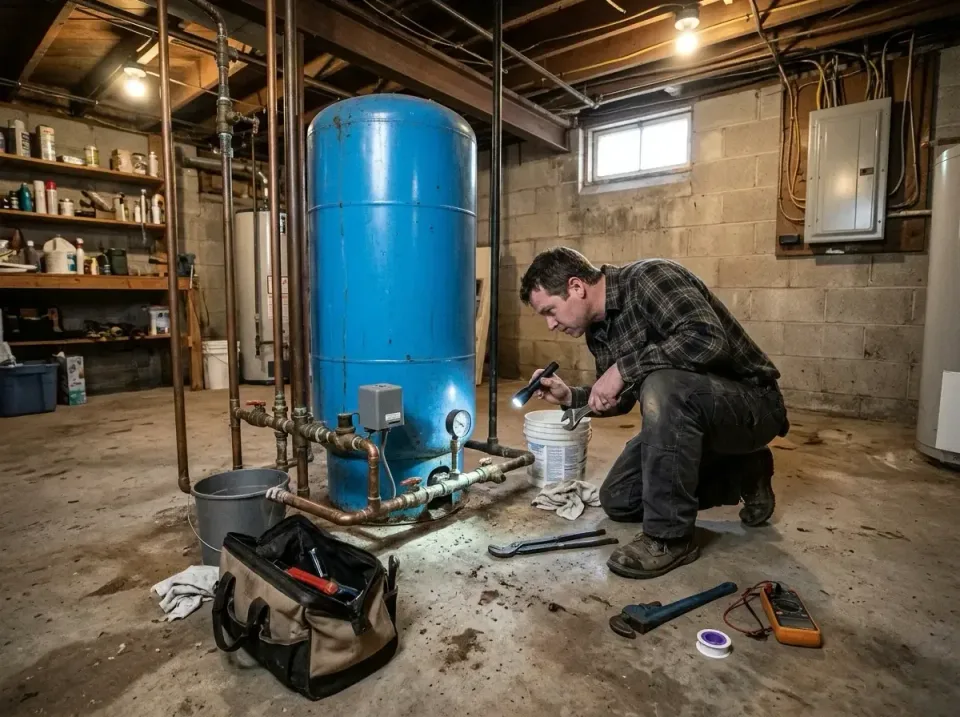
Water Pressure Tank Repair
We repair potable-water pressure tanks for homes, checking tank size and connections; replacement commonly runs $800–$2,500, driven by tank size and installation access.
A weak upstairs shower or a washer that fills slowly is a reason to check a few safe basics before scheduling service. See whether the problem affects one fixture or several, and note whether pressure changes when another tap runs. Don’t open pump controls or adjust wiring. We have seen a small, local symptom lead to a much larger system issue when repeated pump cycling was ignored.
In Juneau, homes near the Juneau Downtown Historic District may have different plumbing layouts and access needs than rural properties; tell us where the equipment sits when describing the issue. Interior Alaska experiences extreme winter cold, so check only visible, accessible piping for obvious frost exposure or damage.
The Alaska State Capitol is a familiar landmark for Juneau-area customers; use it as a general location reference, not a substitute for your service address. Write down what you observe and ask for a diagnosis before approving repairs.
Start by testing a nearby faucet, shower, and toilet separately, then note whether another fixture running changes the flow. If only one tap is weak, check whether its aerator is visibly blocked and whether an accessible fixture shutoff is fully open.
Avoid forcing an old valve; it can leak after being disturbed. If several fixtures fade together, the cause may be upstream of those fixtures, so record that pattern instead of taking plumbing apart.
We ask customers to distinguish a steady weak stream from pressure that surges and fades. Near Ketchikan Creek Street, older or exposed equipment may need careful visual inspection; coastal humidity and salt air can accelerate corrosion on accessible metal components.
Do not scrape, disconnect, or energize corroded parts. A short video of the symptom can help us compare what happens under flowing conditions with what you see at rest.
For a shower-specific example, read why an upstairs shower has weak pressure in Anchorage.
If your system already has a readable gauge, note its reading without changing any settings. A reading while no water is running does not tell the whole story; compare it with a second observation while a faucet runs, and write down both values and the time. Stop if the gauge is damaged, unreadable, or attached to equipment you would have to open to reach it.
This simple record is useful because the Mendenhall Glacier Visitor Center draws visitors through an area where access and weather can change plans; similarly, a clear symptom log helps us prepare for the actual property conditions rather than guess from “pressure is low.” The Nome Anvil City Square is another location reference we recognize, but remote travel details should be confirmed with your service address. A pressure diagnosis is more useful when we know which fixtures were running and whether the pump cycled.
If pressure dropped after an outage, first confirm whether the home’s power has returned and whether other electrical equipment is operating normally. Look at the exterior of the pump area only if it is safely accessible; do not remove a control-box cover or touch wiring. Repeated clicking, humming, or pump starts and stops are reasons to stop troubleshooting and call for help.
Seasonal road access affects remote service scheduling, so let us know if the property requires a longer trip or has limited access. Southcentral winters bring prolonged freezing temperatures, and summer temperatures vary widely across Alaska; both seasonal conditions can affect exposed lines and equipment access.
Ted Stevens Anchorage International Airport is a useful Anchorage-area reference when describing where you are, but we still need the exact service location. For the outage scenario, see low water pressure after a power outage: well pump checks.
Call when multiple fixtures lose flow, visible water appears around a line, pressure drops repeatedly, or the pump cycles without settling. Also stop if a suspected frozen section is hidden in a wall or crawlspace; applying open flame or heat without knowing the pipe route can cause damage or create a fire hazard. Keep your notes, but leave adjustments and electrical checks to a qualified professional.
At the Alaska Native Heritage Center, visitors see how place and conditions shape daily life; in the same way, access and weather matter when planning plumbing work. Heavy snowfall can obstruct outdoor equipment access, so mention buried or snow-covered wellheads when arranging a visit.
We inspect the pressure system, explain the cause in plain language, and recommend a repair suited to your home. For another common pattern, read why faucet pressure drops when another fixture runs in Alaska.
A single weak faucet calls for a different first check than a whole-house pressure drop; match the symptom to the system part before attempting any repair. Keep it observational.
| Option | Best for | Key detail |
|---|---|---|
| Fixture check | One weak faucet or shower | Common household pipe is 1/2–1 inch; inspect only accessible fixture parts. |
| Pressure gauge observation | Pressure changes across the home | Typical household pressure is 40–60 psi; note readings at rest and during flow. |
| Well pressure switch assessment | Pump cycling or broad pressure loss | Common settings include 20/40 or 30/50 psi; do not adjust switch wiring. |
| Tank inspection | Surging or frequent pump starts | Residential tanks range from 20–86 gallons; tank size alone does not show usable drawdown. |
Anchorage 5th Avenue Mall gives customers a familiar city reference when describing where service is needed, but share the property address for planning. In coastal areas, salt air can corrode equipment, so report visible rust rather than trying to loosen fittings.
Snowmelt can raise groundwater around basements; mention dampness near basement lines because it may change the inspection needed. Fairbanks International Airport is a practical regional reference for travel discussions, not a promise of a particular arrival time.
A few safe preparations help us inspect the pressure system without asking you to handle electrical or pressurized components. Keep your notes nearby.
Record the symptom: Write down which fixtures are weak, when it began, and whether running another tap changes the flow.
Note any gauge reading: Record visible readings at rest and during water use; do not adjust equipment to change the number.
Clear a safe route: Move stored items away from the pressure tank or pump area without opening controls.
Mention access conditions: Tell us if the wellhead is under snow or if equipment is in a crawlspace or utility room.
Plan for local conditions: Freeze-thaw cycles stress buried pipes and foundations, so note recent thawing or visible ground movement near lines.
Interior Alaska experiences extreme winter cold, so do not enter an unsafe or unheated space to inspect a line. Anchorage Museum is a useful location reference for Anchorage-area callers, while Nome Airport can help identify a remote service area. Near Juneau Downtown Historic District, access to equipment may differ by property; include those details when scheduling.
A slowly filling washer with normal faucets points first to that appliance’s supply valves, hose, or inlet screen, so check only accessible parts and avoid forcing a stuck valve. Interior summers can bring warm days and cool nights, which can make exposed plumbing conditions change; note whether the symptom follows a cold night.
Pressure diagnosis is $100–$300 for testing and travel, with the visit used to identify whether the issue is at a fixture, tank, pump, or line. Heavy snowfall can obstruct outdoor equipment access, so tell Alaska Plumbing Pros if the wellhead or pump area needs clearing before the inspection.
No, stop DIY checks if the pump starts and stops repeatedly; record how often it cycles and leave electrical controls closed. Near the Alaska Highway, travel distance and service access can affect scheduling, so share the exact location and symptoms when arranging help.
Anchorage plumbing permits should be verified before alterations, and pump wiring work may require Anchorage electrical permit approval. Alaska Statutes 08.18 sets contractor registration requirements, so ask who will perform the work and whether the planned repair requires approval.
Yes, a tank or pump control problem can contribute to pressure loss after an outage, especially if the pump does not restart normally; do not open its electrical enclosure. A related next step may be Water Pressure Tank Repair, and Alaska SeaLife Center is a recognizable Seward-area reference when explaining where the property is located.
A weak fixture, repeated pump cycling, or pressure that fades across several rooms is worth documenting before you call. Share what changed, which taps you tested, and whether the pump made unusual sounds. We will inspect the system and explain what we find before recommending work.
Alaska’s weather can expose plumbing to high winds that damage exposed components, so mention any outdoor equipment that looks shifted or loose. Near Matanuska Glacier, a landmark can help orient a service conversation, while Wrangell-St.
Elias National Park and Preserve is a reminder that some Alaska trips involve substantial distance; provide your exact location when requesting service. For well-system concerns, contact Alaska Plumbing Pros about well pump repair.
A slowly filling washer with normal faucets points first to that appliance’s supply valves, hose, or inlet screen, so check only accessible parts and avoid forcing a stuck valve. Interior summers can bring warm days and cool nights, which can make exposed plumbing conditions change; note whether the symptom follows a cold night.
Pressure diagnosis is $100–$300 for testing and travel, with the visit used to identify whether the issue is at a fixture, tank, pump, or line. Heavy snowfall can obstruct outdoor equipment access, so tell Alaska Plumbing Pros if the wellhead or pump area needs clearing before the inspection.
No, stop DIY checks if the pump starts and stops repeatedly; record how often it cycles and leave electrical controls closed. Near the Alaska Highway, travel distance and service access can affect scheduling, so share the exact location and symptoms when arranging help.
Anchorage plumbing permits should be verified before alterations, and pump wiring work may require Anchorage electrical permit approval. Alaska Statutes 08.18 sets contractor registration requirements, so ask who will perform the work and whether the planned repair requires approval.
Yes, a tank or pump control problem can contribute to pressure loss after an outage, especially if the pump does not restart normally; do not open its electrical enclosure. A related next step may be Water Pressure Tank Repair, and Alaska SeaLife Center is a recognizable Seward-area reference when explaining where the property is located.
Browse all nationwide service options and choose the right fit for your project.
We repair potable-water pressure tanks for homes, checking tank size and connections; replacement commonly runs $800–$2,500, driven by tank size and installation access.
Booster Pump Repair covers pump diagnostics and component fixes for homes with inconsistent supply; typical repairs run $300–$1,200, depending on parts and diagnostics.
Well Pump Repair covers pump testing and repairs for homes, with replacement costs of $1,200–$4,500 depending on pump depth and type.
We repair leaking water lines for homeowners and contractors, including accessible pipe sections and excavation; repairs commonly run $400–$3,000 depending on pipe access.
Frozen Pipe Repair for Alaska homes includes locating and safely thawing frozen pipe sections; access, pipe material, and any split line affect the job scope.
We repair residential pressure regulators, checking valve condition and system readings; access and regulator size shape the job, typically $150–$400.
We diagnose sudden household pressure drops, testing flowing and static readings and system controls. Typical diagnostic visits run $100–$300, depending on testing and travel.
We repair or replace household shutoff valves, including accessible copper and PEX connections; typical jobs run $150–$500 depending on access and valve condition.
Clear clogged residential water lines and inspect accessible pipe sections; typical jobs run $250–$1,500, with price driven by blockage and access.
We repair well pressure switches for homeowners, including switch and wiring access; typical replacement runs $200–$600, depending on access.
Goulds Well Pump Repair covers residential pump diagnosis and component repairs; access, pump depth, and parts availability shape the job cost.
We repair residential water softeners, including control and resin-bed issues; diagnostic work is $100–$300, depending on testing and travel.
Shallow Well Pump Repair covers pump, foot-valve, and check-valve faults for private-well homes; access, pump type, and well depth shape the job cost.
Sediment Filter Replacement clears packed grit from residential filter housings; typical cartridge jobs run $150–$450, depending on filter size and access.
Air-in-line diagnosis and repair for Alaska homes, including accessible water-line checks; typical service runs $150–$500, depending on access and repair scope.
Submersible pump repair for Alaska homes includes well-depth and pump checks; replacement work typically runs $1,200–$4,500, depending on depth and pump type.
Grundfos Booster Pump Repair in Alaska: diagnose pump faults, inspect controls, and repair components. Call (877) 773-0781 for a scope review.
Select a city to find local low water pressure repair providers we cover in Alaska.
Share your job scope for low water pressure repair in Alaska — we will review fit and pricing before scheduling.