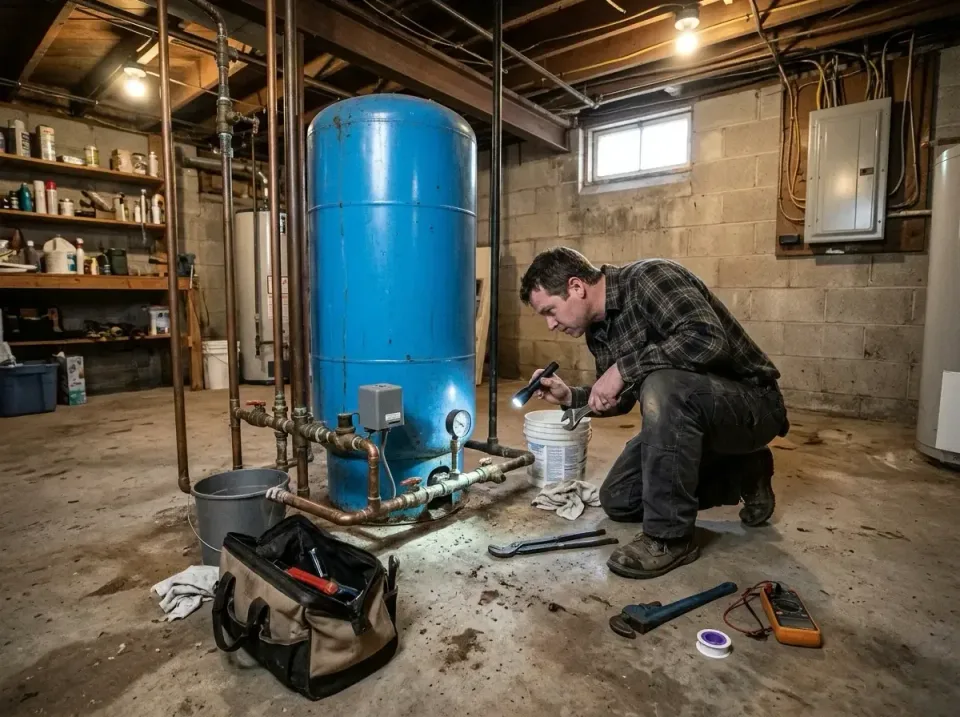
Water Pressure Tank Repair
We repair potable-water pressure tanks for homes, checking tank size and connections; replacement commonly runs $800–$2,500, driven by tank size and installation access.
A pump that clicks repeatedly while water pressure rises and falls may have a failing pressure switch, but the switch is not the only possible cause. A weak upstairs shower or a faucet that loses force during use can also point to a pump, tank, or water-supply problem. Compare the symptoms before replacing parts.
In our experience, homeowners often skip checking whether the pump starts and stops at consistent pressure readings; that detail helps distinguish switch trouble from a wider system issue. Long winters increase frozen-pipe and well-system risks, so pressure loss in Alaska deserves a prompt check for both control and supply problems.
Nome Anvil City Square is a useful reminder of the distances between communities; for customers near Nome, access planning can matter alongside the diagnosis. We can inspect the system and explain what to check next.
A pump that fails to start when pressure falls, runs on without stopping, or clicks on and off repeatedly may have switch trouble. Compare that behavior with the pressure gauge: does the reading rise as the pump runs, then fall as water is used?
A switch senses pressure and controls pump cycling, so inconsistent operation matters more than one weak tap. Heavy snowfall can obstruct access to outdoor equipment, so clear a safe route to the wellhead before arranging an inspection; do not climb onto equipment or dig around buried lines.
The Alaska Highway connects distant communities, and winter travel can make good access information important when planning a service visit. Our crew checks the gauge and control operation before recommending replacement.
A worn switch is only one possibility. A waterlogged pressure tank can leave little usable drawdown, and a pump problem can prevent pressure from recovering even if the switch calls for operation.
A pressure tank inspection can help separate those causes. If flow fades only while several taps run, the issue may be elsewhere in the supply system rather than at the switch.
Interior summers can bring warm days and cool nights; large daily temperature shifts are a reminder to keep exposed equipment and piping protected as conditions change. For broader symptoms, see our guide to faucet pressure drops when another fixture runs.
You can safely note when the pump starts and stops, check whether a breaker has tripped, and keep the area around the equipment accessible. Stop there if inspection requires opening a live electrical control box or changing switch settings.
Those contacts carry electrical risk, and adjustment without a pressure reading can create a cycling problem or push the system outside its intended range. Katmai National Park and Preserve is remote; in similarly distant communities, accurately describing the symptom and access conditions helps the service team plan the visit.
We diagnose before replacing parts, explain the findings plainly, and recommend a repair suited to the home and its water system.
Ask whether the diagnosis confirmed that the switch fails to respond to changing pressure, whether wiring or pump operation was checked, and whether the tank or water supply could explain the same symptoms. Alaska SeaLife Center draws visitors to Seward, where marine conditions are part of local life; across Alaska, the service environment can differ, so equipment condition and access should be considered at the home.
A replacement should match the system’s requirements, not simply the old part’s appearance. Read our well pump cycling guide if repeated starts are the main symptom.
If the pump cycles oddly but other parts seem sound, compare the switch with the tank and supply before choosing a repair. Corrosion deserves attention in coastal settings: humidity and salt air can speed wear on exposed metal contacts, so inspect the control enclosure rather than judging by pressure symptoms alone.
High winds can damage exposed plumbing components; secure and protect outdoor equipment when appropriate. Southcentral winters bring prolonged freezing temperatures, so exposed lines also need inspection before assuming a control fault.
| Option | Best for | Key detail |
|---|---|---|
| Pressure switch replacement | Pump fails to start or stop at the expected point | Compare operation with the system’s gauge readings |
| Pressure tank service | Pump cycles frequently and usable water reserve seems low | Tank drawdown is not the same as tank storage capacity |
| Booster pump troubleshooting | Pressure needs support beyond the well system | Booster pumps are sized by flow and pressure |
| Pressure regulator repair | Pressure is being reduced downstream | A regulator reduces pressure rather than raising it |
Ask what test supports the proposed repair and whether the pump and tank were checked too.
Before booking service, make the well equipment accessible and write down what the water is doing. Interior Alaska experiences extreme winter cold, so tell the plumber if the wellhead or access path is snow-covered; Matanuska Glacier is a familiar regional landmark, but conditions at individual properties can differ. Summer temperatures vary widely across Alaska, making year-round protection and access planning useful.
Describe the symptom: Note whether the pump fails to start, keeps running, or cycles repeatedly when a fixture is used.
Clear the equipment area: Locate the wellhead, pressure tank, and shutoff, then move stored items away from controls.
Arrange entry: Confirm access to the utility room or crawlspace and clear the route for equipment.
Plan winter access: Identify snow-covered wellheads or icy paths before the appointment; do not expose yourself to unsafe conditions.
Keep controls closed: Leave electrical inspection and switch adjustment to a qualified professional.
Allow for interrupted water: Plan for a temporary water interruption while the system is inspected or repaired.
Yes, a pump that does not restart after an outage can have a switch or electrical-control issue, but the outage alone does not confirm the cause. Note whether the breaker is tripped and whether the pump makes any sound; do not open the control box. Near the Anchorage Alaska Railroad Depot or elsewhere, access to the home’s equipment matters for checking the system safely.
Pressure switch replacement is typically $200–$600, with the switch and wiring access affecting the work. A pressure diagnosis is typically $100–$300 for testing and travel, which can help confirm whether the switch or another part is responsible. The Anchorage Museum is a recognizable local reference, but site access and the equipment condition not proximity to a landmark shape the visit.
No, do not adjust the switch if doing so requires opening an electrical control box or changing settings without testing. You can record when the pump starts and stops, then share that information with a plumber; our crew can assess the control and system safely. Near Eagle River Nature Center or in other areas with longer access routes, describing site conditions helps with planning.
Anchorage plumbing permits should be checked before alterations, and pump wiring work may require Anchorage electrical permit approval. The Alaska Plumbing Code covers applicable plumbing installation requirements, while Alaska Statutes 08.18 addresses contractor registration requirements. Ask whether the proposed work involves a plumbing alteration or pump wiring so the requirements can be verified.
Yes, Southeast Alaska’s maritime, rainy climate can make inspection of exposed equipment and its enclosure especially useful. Ask the technician to check for moisture-related wear while diagnosing the cycling problem rather than assuming a new switch alone will solve it. Fairbanks International Airport is another useful statewide reference, but coastal and interior service conditions are not interchangeable.
A pressure switch should be replaced when testing shows it is not responding properly not simply because water pressure feels low. Repeated cycling, weak flow, or a pump that does not stop are good reasons to arrange an inspection.
Freeze-thaw cycles stress buried pipes and foundations, so a pressure problem can involve more than the switch; Bering Land Bridge National Preserve also reflects how remote Alaska locations can make advance access planning important. Tony Knowles Coastal Trail offers an Anchorage landmark, while customers elsewhere may have different site conditions to report.
We’ll inspect the system and explain the likely cause in plain language. For a next step, request well pressure switch repair from Alaska Plumbing Pros.
Yes, a pump that does not restart after an outage can have a switch or electrical-control issue, but the outage alone does not confirm the cause. Note whether the breaker is tripped and whether the pump makes any sound; do not open the control box. Near the Anchorage Alaska Railroad Depot or elsewhere, access to the home’s equipment matters for checking the system safely.
Pressure switch replacement is typically $200–$600, with the switch and wiring access affecting the work. A pressure diagnosis is typically $100–$300 for testing and travel, which can help confirm whether the switch or another part is responsible. The Anchorage Museum is a recognizable local reference, but site access and the equipment condition not proximity to a landmark shape the visit.
No, do not adjust the switch if doing so requires opening an electrical control box or changing settings without testing. You can record when the pump starts and stops, then share that information with a plumber; our crew can assess the control and system safely. Near Eagle River Nature Center or in other areas with longer access routes, describing site conditions helps with planning.
Anchorage plumbing permits should be checked before alterations, and pump wiring work may require Anchorage electrical permit approval. The Alaska Plumbing Code covers applicable plumbing installation requirements, while Alaska Statutes 08.18 addresses contractor registration requirements. Ask whether the proposed work involves a plumbing alteration or pump wiring so the requirements can be verified.
Yes, Southeast Alaska’s maritime, rainy climate can make inspection of exposed equipment and its enclosure especially useful. Ask the technician to check for moisture-related wear while diagnosing the cycling problem rather than assuming a new switch alone will solve it. Fairbanks International Airport is another useful statewide reference, but coastal and interior service conditions are not interchangeable.
Browse all nationwide service options and choose the right fit for your project.
We repair potable-water pressure tanks for homes, checking tank size and connections; replacement commonly runs $800–$2,500, driven by tank size and installation access.
Booster Pump Repair covers pump diagnostics and component fixes for homes with inconsistent supply; typical repairs run $300–$1,200, depending on parts and diagnostics.
Well Pump Repair covers pump testing and repairs for homes, with replacement costs of $1,200–$4,500 depending on pump depth and type.
We repair leaking water lines for homeowners and contractors, including accessible pipe sections and excavation; repairs commonly run $400–$3,000 depending on pipe access.
Frozen Pipe Repair for Alaska homes includes locating and safely thawing frozen pipe sections; access, pipe material, and any split line affect the job scope.
We repair residential pressure regulators, checking valve condition and system readings; access and regulator size shape the job, typically $150–$400.
We diagnose sudden household pressure drops, testing flowing and static readings and system controls. Typical diagnostic visits run $100–$300, depending on testing and travel.
We repair or replace household shutoff valves, including accessible copper and PEX connections; typical jobs run $150–$500 depending on access and valve condition.
Clear clogged residential water lines and inspect accessible pipe sections; typical jobs run $250–$1,500, with price driven by blockage and access.
We repair well pressure switches for homeowners, including switch and wiring access; typical replacement runs $200–$600, depending on access.
Goulds Well Pump Repair covers residential pump diagnosis and component repairs; access, pump depth, and parts availability shape the job cost.
We repair residential water softeners, including control and resin-bed issues; diagnostic work is $100–$300, depending on testing and travel.
Shallow Well Pump Repair covers pump, foot-valve, and check-valve faults for private-well homes; access, pump type, and well depth shape the job cost.
Sediment Filter Replacement clears packed grit from residential filter housings; typical cartridge jobs run $150–$450, depending on filter size and access.
Air-in-line diagnosis and repair for Alaska homes, including accessible water-line checks; typical service runs $150–$500, depending on access and repair scope.
Submersible pump repair for Alaska homes includes well-depth and pump checks; replacement work typically runs $1,200–$4,500, depending on depth and pump type.
Grundfos Booster Pump Repair in Alaska: diagnose pump faults, inspect controls, and repair components. Call (877) 773-0781 for a scope review.
Select a city to find local low water pressure repair providers we cover in Alaska.
Share your job scope for low water pressure repair in Alaska — we will review fit and pricing before scheduling.